Here it is!
See you in Chios soon,
--petros
ps. In the next few days, I will invite you to a special event to discuss on the organization and value delivery of my course... Please check your e-mail regularly!
Thursday, April 19, 2007


Wednesday, February 14, 2007
tenth lecture: applications and work-in-class!
Hello,
In this final session, the class will work on two applications of the knowledge acquired during the semester.
The first application refers to the role of users preferences in the technology evolution [please make the link with value networks concepts]. Paper to be discussed and presented from students: M. Tripsas, 2001, Understanding the timing of technological transitions: The role of user preferences, Harvard Business School Working Paper)The
The second application is an A-Z case of strategic analysis and choice, with reference to Ryanair, an EU low fare airlines company [please make the with Delta model approach]. Paper to be discussed and presented from students: Case: Ryanair (Pearson Education Limited 2005).
--petros
In this final session, the class will work on two applications of the knowledge acquired during the semester.
The first application refers to the role of users preferences in the technology evolution [please make the link with value networks concepts]. Paper to be discussed and presented from students: M. Tripsas, 2001, Understanding the timing of technological transitions: The role of user preferences, Harvard Business School Working Paper)The
The second application is an A-Z case of strategic analysis and choice, with reference to Ryanair, an EU low fare airlines company [please make the with Delta model approach]. Paper to be discussed and presented from students: Case: Ryanair (Pearson Education Limited 2005).
--petros
Monday, February 12, 2007
eighth and nineth lecture: business value networks and technology development
Hello,
These two lectures focus on explaining further the concept of "value network" as a nested network of producers and markets (users / consumers). Very frequently, the scope and the boundaries of a value network are defined by the corresponding "technological trajectory" (another concept investigated by this lecture). This implies that a value network embodies a specific problem solving agenda built on its own rank-ordering of important product attributes. As a result, various value network co-exist at the same time, with business companies eventually participating in more than one. More important, the co-existence of various value networks creates sometimes the conditions of the emergence of a disruptive innovation. This is what C. Christensen explains in the "Innovator's Dilemma"...
These two lectures focus on explaining further the concept of "value network" as a nested network of producers and markets (users / consumers). Very frequently, the scope and the boundaries of a value network are defined by the corresponding "technological trajectory" (another concept investigated by this lecture). This implies that a value network embodies a specific problem solving agenda built on its own rank-ordering of important product attributes. As a result, various value network co-exist at the same time, with business companies eventually participating in more than one. More important, the co-existence of various value networks creates sometimes the conditions of the emergence of a disruptive innovation. This is what C. Christensen explains in the "Innovator's Dilemma"...
- Course Repository / Lecture notes : Download my presentation
- Course Repository / Calendar & Readings: Please read carefully the online paper and C. Christensen book's chapter from business week
Wednesday, January 31, 2007
seventh lecture: strategy in the context of network business (from value chain to value nets)
Hello,
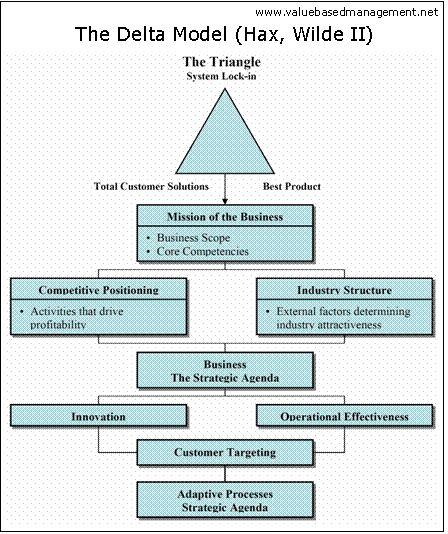
Lecture 7 moves the discussion towards strategizing beyond product development and competences / dynamic capabilities. It focus on Delta Model, a strategic framework that: a) places the customer at the center of management, b) integrates strategy with execution through the concept of Adaptive Process.
--petros
Lecture 7 moves the discussion towards strategizing beyond product development and competences / dynamic capabilities. It focus on Delta Model, a strategic framework that: a) places the customer at the center of management, b) integrates strategy with execution through the concept of Adaptive Process.
- Course Repository / Lecture notes : Download Lecture 7's presentation (parts 1 and 2) -- from Prof. Hax, MIT
- Course Repository / Calendar & Readings: Please download the paper and visit the suggested link
--petros
Saturday, January 27, 2007
sixth lecture: strategy implmentation
Hello,
Lecture 6 focuses on organizational structure / design in the context of strategic management of business organizations. Strategy is formed somehow at the top of SBUs and within the corporate management bodies, so the configuration of an organization towards implementing a strategy becomes a complex task that involves much more constituents than any previous stage of the strategic management process. In particular, this Lecture will overview various organization structures and organizational design forms while focusing on the concept of "networked (or extended) business".
--petros
Lecture 6 focuses on organizational structure / design in the context of strategic management of business organizations. Strategy is formed somehow at the top of SBUs and within the corporate management bodies, so the configuration of an organization towards implementing a strategy becomes a complex task that involves much more constituents than any previous stage of the strategic management process. In particular, this Lecture will overview various organization structures and organizational design forms while focusing on the concept of "networked (or extended) business".
- Course Repository / Lecture notes : Download my presentation
- Course Repository / Calendar & Readings: Please read recent posts in "Calendar & Readings" Category (a paper on Supply Chain Organization and two cases related to this Lecture)
--petros
Thursday, January 18, 2007
fifth lecture: strategic choice
Hello,

Fifth Lecture brings strategic management to life as the course moves from Strategic Analysis to Strategic Choice . Various alternative types of strategies, broad and narrow, are defined and exemplified. Guidelines are presented when different types of strategies are most appropriate to pursue.

- Course Repository / Lecture notes : Download my presentation
- Course Repository / Calendar & Readings: Please read carefully, recent posts in "Calendar & Readings" Category (two new cases have been uploaded)
- Reminder: 1st in-vivo test finally today: Thursday 18.01.2007 at 3pm!
Monday, January 8, 2007
fme masters googlegroup: media for co-ordination
Hello,
For the needs of our co-ordination, I have created a googlegroup (fmemasters [AT] googlegroup). It should help us in the preparation of the special lecture on "in.gr leadership". Please enjoy and use it as much as you can! Please notice that the googlegroup site (http://groups-beta.google.com/group/fmemasters) keeps memory of sent mails to the list. Go there and ask your knowlegable colleaugues all the questions you may have on how to use it...
Cheers,
--petros
For the needs of our co-ordination, I have created a googlegroup (fmemasters [AT] googlegroup). It should help us in the preparation of the special lecture on "in.gr leadership". Please enjoy and use it as much as you can! Please notice that the googlegroup site (http://groups-beta.google.com/group/fmemasters) keeps memory of sent mails to the list. Go there and ask your knowlegable colleaugues all the questions you may have on how to use it...
Cheers,
--petros
Friday, January 5, 2007
new upload
Hello,
Today, I have upoaded two sections from an interesting book of P. Gemawat (Harvard Business School), entitled "Strategy and the Business Landscape: Text and Cases". They refer, respectively, to "Resources" and "Capabilities themes". Please visit "Calendar and Readings" Section to get them!
See you on Wednesday,
--petros
Today, I have upoaded two sections from an interesting book of P. Gemawat (Harvard Business School), entitled "Strategy and the Business Landscape: Text and Cases". They refer, respectively, to "Resources" and "Capabilities themes". Please visit "Calendar and Readings" Section to get them!
See you on Wednesday,
--petros
Tuesday, January 2, 2007

Wednesday, December 20, 2006
forth lecture: internal analysis (part II)
Hello,
Fourth Lecture continues on material exposed in Lecture 3. The notion of "competences" is explained in depth with reference to BMW and F1 cases. The importance of competences is also illustrated by Southwest airlines case which provides anm interesting definition of competence as "recipy" of how to maximize the use of one specific type of resource. Furthermore, this Lecture gives a dynamic definition of competences and introduces the notion of "developing capabilities over time" as a prerequisite for sustainable competitive advantage. In fact, it appears that superior capabilities can lead to superior performance, by improving the terms on which resource commitments can be made and rise barriers to imitation...
--petros
Fourth Lecture continues on material exposed in Lecture 3. The notion of "competences" is explained in depth with reference to BMW and F1 cases. The importance of competences is also illustrated by Southwest airlines case which provides anm interesting definition of competence as "recipy" of how to maximize the use of one specific type of resource. Furthermore, this Lecture gives a dynamic definition of competences and introduces the notion of "developing capabilities over time" as a prerequisite for sustainable competitive advantage. In fact, it appears that superior capabilities can lead to superior performance, by improving the terms on which resource commitments can be made and rise barriers to imitation...
- Course Repository / Calendar & Readings: Please read carefully recent posts in "Calendar & Readings" Category
- Reminder: 1st in-vivo test (with reference to Lectures 1, 2, 3, 4): Wednesday 10.01.2007 at 6pm!
--petros
Wednesday, December 13, 2006
third lecture: internal analysis
Hello,
Lecture 3 focuses on identifying and evaluating a firm’s strengths and weaknesses in the functional areas of business, including management, marketing, finance/accounting, production/operations, research and development, and management information systems. Relationships among these areas of business and the strategic implications of important functional area concepts are examined. Strategies are formulated that take advantage of an organization’s internal strengths and improve upon weaknesses. The Resource-Based View (RBV) of strategic management is introduced as well as the Value Chain Analysis (VCA) concept; the importance of resources and competences, in terms of creating competitive advantage, is explained in depth through two cases form the automobile industry.
- Course Repository / Lecture notes : Download my presentation
- Course Repository / Calendar & Readings: Please read carefully the case-studies (3) I have uploaded (ask for password!)
- Reminder: 1st in-vivo test (with reference to Lectures 1, 2, 3, 4): Wednesday 10.01.2007 at 6pm!
Wednesday, December 6, 2006
second lecture: external analysis
Hello,
Lecture 2 examines the tools and concepts needed to conduct an external strategic-management industry analysis (sometimes called environmental scanning or external audit). An external analysis focuses on identifying and evaluating trends and events beyond the control of a single firm, such as increased foreign competition, demographic or cultural changes and, generally, macro-environment influences. An external analysis reveals key opportunities and threats confronting an organization, so managers can formulate strategies to take advantage of the opportunities and avoid or reduce the impact of threats. This lecture presents a practical framework and guidelines for gathering, assimilating, and analyzing environmental information. The Industrial Organization (I/O) view of strategic management is introduced.

Lecture 2 examines the tools and concepts needed to conduct an external strategic-management industry analysis (sometimes called environmental scanning or external audit). An external analysis focuses on identifying and evaluating trends and events beyond the control of a single firm, such as increased foreign competition, demographic or cultural changes and, generally, macro-environment influences. An external analysis reveals key opportunities and threats confronting an organization, so managers can formulate strategies to take advantage of the opportunities and avoid or reduce the impact of threats. This lecture presents a practical framework and guidelines for gathering, assimilating, and analyzing environmental information. The Industrial Organization (I/O) view of strategic management is introduced.

- Course Repository / Lecture notes : Download my presentation
- Course Repository / Calendar & Readings: Please read the case-study (ask for password!)
- Assignment: Download the second assignment from here (pdf file) / deadline 11.12.2006, 13:00h / please reply by SMS, see assignment document for guidance.
Monday, December 4, 2006
register in this course
Hello,
Please take two minutes to register in this course. Click on the title of this post to get the registration page. When you go there, you are requested to fill the form and submit (add / προσθήκη). If possible, do that before next Wednesday!
thanks,
--petros
Please take two minutes to register in this course. Click on the title of this post to get the registration page. When you go there, you are requested to fill the form and submit (add / προσθήκη). If possible, do that before next Wednesday!
thanks,
--petros
Saturday, December 2, 2006
first assignment
Hello,
Thanks for participating, all of you and in time! In fact, I got 25 responses! Now, my teaching assistants will go through your sms replies to attribute points as follows: correct answer = 2 points; wrong answer = 0 points (please, let us know on next Wednesday about summary of results per student).
Correct answers: 1B/2A/3C/4A/5A
--petros
Thanks for participating, all of you and in time! In fact, I got 25 responses! Now, my teaching assistants will go through your sms replies to attribute points as follows: correct answer = 2 points; wrong answer = 0 points (please, let us know on next Wednesday about summary of results per student).
Correct answers: 1B/2A/3C/4A/5A
--petros
Wednesday, November 29, 2006
first lecture: introduction
Hello,
The introductive lecture provides an overview of organizations purposes and strategic management processes. A practical, integrative model of the strategic-management process is introduced. Basic activities and terms in organizational economics and strategic management are defined. A vocabulary of strategy is discussed (follows).
 source: Course Textbook
The introductive lecture provides an overview of organizations purposes and strategic management processes. A practical, integrative model of the strategic-management process is introduced. Basic activities and terms in organizational economics and strategic management are defined. A vocabulary of strategy is discussed (follows).
 source: Course Textbook
- Lecture notes: Download my presentation from here (ppt file) or here (pdf file)
- Readings: Course Textbook Chapter 1 (Corporate Strategy: An Introduction) + Download (from here) the paper "The New Strategy and Why It Is New" (by N. Demos, St. Chung, and M. Beck) published in strategy+business (pdf file)
- Assignment: Download the first assignment from here (pdf file) / deadline 02.12.2006, 13:00h / please reply by SMS, see assignment document for guidance.
Tuesday, November 28, 2006
students evaluation: contributing factors
- Class Participation and short tests (15%)
- Three (3) Multiple-Choice in-vivo Tests during the semester (10% each)
- Final Exam (55%).
what you will learn in this course
1. A set of fundamental concepts for understanding the process of how business (what is this exactly?) organize to meet the objectives they fix:
- Strategy and strategic management
- Positioning in the competition and sustainable competitive advantage
- Technological innovation and how to create and capture value from it
- Leverage opportunities in the knowledge / information economies
about this course
This course focuses on some of the important current issues in strategic management and management of technology. It is intended to provide the students with an intellectual framework that will guide the formulation and implementation of corporate strategies - with emphasis to strategies that fit with the emerging collaborative business enviroment and leverage the potential of IT technologies.
The course utilizes lectures and independent reading. The readings (textbook chapters and papers) are primarily drawn from strategic management literature, economics of technical change, behavioral and organizational economics, and from research conducted in engineering and business schools environments. A few of the journal articles are quite difficult. The appropriation from the students of the content of these book chapters and papers will be considered as the essential part of the student evaluation process.
Course Meeting Times Lectures: Ten Lectures
Level: Graduate
The course utilizes lectures and independent reading. The readings (textbook chapters and papers) are primarily drawn from strategic management literature, economics of technical change, behavioral and organizational economics, and from research conducted in engineering and business schools environments. A few of the journal articles are quite difficult. The appropriation from the students of the content of these book chapters and papers will be considered as the essential part of the student evaluation process.
Course Meeting Times Lectures: Ten Lectures
- One Lecture / Week
- Three Hours / Lecture
Level: Graduate
Subscribe to:
Comments (Atom)

